
Fact check: the Emsella chairThe Emsella chair: does it help your pelvic floor muscles
The Emsella chair jerks your pelvic floor muscles with a magnetic field while you sit. For a healthy woman this is not training but stimulation: the brain is not involved, no skill appears, and the result goes away together with the sessions. It can help those who cannot feel the muscles at all.



Key points
- Emsella is magnetic stimulation: in one session the muscles contract thousands of times without your involvement.
- Training is a command from the brain: “squeeze, lift, relax”. Without the command no skill forms, so the effect of the chair is temporary.
- Electrical stimulation was invented for people with atrophy and loss of sensation in the muscles. For a healthy woman it is no substitute for working with a trainer.
- With significant prolapse the chair will not help, and after a session there can be aching pain and spasms.
- In every protocol the first line for incontinence is pelvic floor muscle training, and with a trainer it goes faster.
This material is educational and does not replace a doctor’s consultation.
Does the Emsella chair help your pelvic floor muscles
For a healthy woman, no. The Emsella chair contracts the pelvic floor muscles with a magnetic field while you sit on it fully clothed. The muscle twitches thousands of times per session, and during the course of sessions you get a feeling of tone. But the skill of controlling the muscle does not form, because the brain takes no part in it, and the result lasts exactly as long as you keep going to the clinic.
I have been working with women’s pelvic floor muscles for more than ten years, more than 20,000 students have gone through my programs, and I have sat on this chair myself at maximum power. I have no goal of bashing it: if it worked, I would be the first to say so. But women regularly come to me after two or three sessions with nothing changed. If there had been an effect, they would not be looking for a solution further.
Below I will explain how the chair works, where the idea of stimulating muscles with current and magnets came from, who it really helps and why for most women training with a trainer gives more in five minutes a day.
How the Emsella chair works
Under the seat there is an electromagnetic coil. It creates a focused magnetic field that causes the pelvic floor muscles to contract. The manufacturer calls the technology HIFEM and promises thousands of contractions in a session of about half an hour. You sit, you can read or scroll your phone, and the muscle contracts on its own.
Sounds like a dream: a strong pelvic floor without effort. That is exactly how clinics sell it: “sit for a while, leave with strong muscles”. A course is usually six sessions, then maintenance sessions are recommended. This is where it is worth stopping and asking: what exactly happens to the muscle when it is jerked from the outside?
What happens is a contraction without a command. This is an important difference, and below I will show why it means the chair does not replace training.
| The Emsella chair | Training with a trainer | |
|---|---|---|
| Who gives the muscle the command | A magnetic field | You, with your brain |
| Load | None, the muscle twitches idly | Yes: a ball, a laser trainer |
| Teaches relaxing | No | Yes, it is half the work |
| Control in daily life: sneezing, jumping, sex | Does not appear | Appears within a few weeks |
| Result after it ends | Goes away together with the sessions | Stays, the skill is yours |
| Time | Travel, the clinic, about an hour, six times plus maintenance | Five minutes in the evening at home |
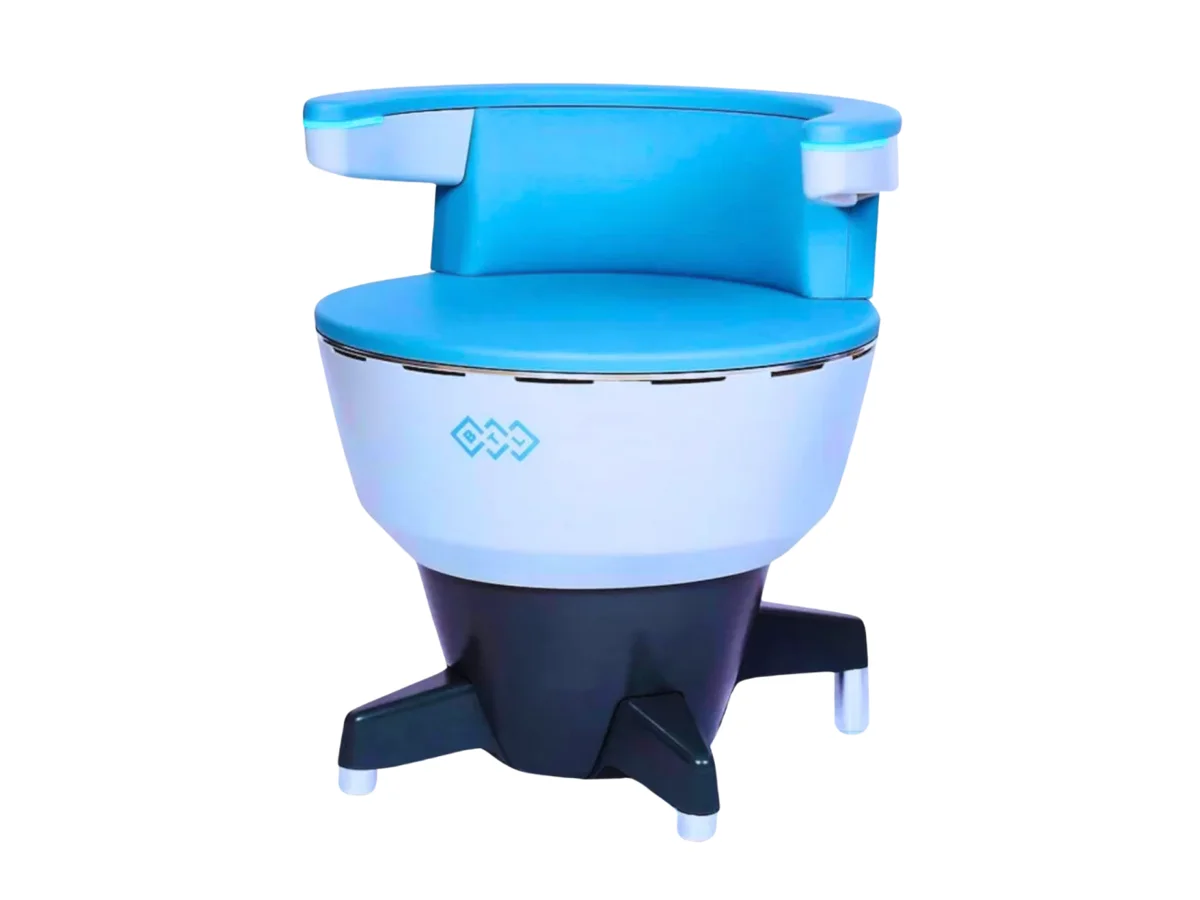
The Emsella chair: a magnetic field under the seat contracts the pelvic floor muscles thousands of times per session. You sit, the muscle twitches, the brain is not involved.
Where electrical muscle stimulation came from
The idea of making a muscle contract with an electrical or magnetic impulse was born in rehabilitation. In people after spinal cord injuries and other nerve damage, muscles stop receiving commands, stop working and atrophy. To preserve their volume and function, the muscle began to be contracted by an impulse from the outside. For such patients it is real help: they have no other way to make the muscle work.
Then the technology moved on to healthy people. The logic is clear: if stimulation maintains the muscle of someone who cannot control it, why not sell it to everyone? That is how machines for the abs, for the glutes and a chair for the pelvic floor appeared. Only the task changed: a healthy woman does not need to save her muscle from atrophy. She needs to learn to control it, and stimulation does not teach that.
A simple check. If electrical stimulation built strong muscles in healthy people, bodybuilders would prepare for competitions lying on a couch with wires attached, not in the gym with a barbell. But they are still in the gym. Because a muscle grows and learns where there is load and a command from the brain.
Why it is not training: the brain is not involved
Pelvic floor muscle training is not just contractions. It is the command “squeeze, lift, relax”, which you give yourself, again and again. Each such command builds a connection between the brain and the muscle. After a few weeks you feel your muscles at any moment of the day, you can tighten them before a sneeze, relax them during intimacy, hold them when you jump. This is what control means, and it is control that solves leaking, not the size of the muscle itself.
Strong pelvic floor muscles are not the ones that twitch the hardest. They are the ones you know how to command: squeeze, lift, relax.
On the chair there is no command. The magnetic field jerks the muscle while the brain is busy with a magazine. No neural connection is built, no habit forms, and as soon as the sessions end, the muscle returns to its previous state, because it never became yours.
There is also a second half that nobody on the chair talks about at all: relaxation. Half of the women who come to me with pain during sex and with “the muscles are there, but there are no sensations” suffer not from weakness but from spasm. Such muscles need not strengthening but the ability to let go. The chair does not teach relaxation in any way: it only contracts. For a woman with hypertonus it can make things worse.
And third. When a woman sits on the chair, she gets nothing for her head or her state: no work with shame, with “I must” beliefs or with her inner resources. Yet desire and pleasure do not live only in the muscles, my method has three levels, and the chair does not fully cover any of them.
What research and protocols say
The most reliable source on pelvic floor muscles is the 2018 Cochrane review: pelvic floor muscle training in women with stress incontinence raises the chance of a cure many times over compared with no treatment, which is why it is recommended as the first line. The British NICE guideline says the same: at least three months of training supervised by a specialist as the first step for incontinence and mild prolapse.
On electrical stimulation the same NICE is reserved: do not use it routinely, and keep it for women who cannot contract their pelvic floor muscles on their own. That is, exactly for the task stimulation was once invented for.
There are few studies of the chair itself, they are small, often without a comparison group and with short follow-up, and many were done with the manufacturer’s involvement. They show improvement during the course, and that does not contradict what I see: while you keep sitting, there is tone. The question is what remains six months later. There are no serious answers to that question yet.
My experience on the chair and what my students say
I sat on the chair out of curiosity and asked them to turn on maximum power. Two observations.
First: these are painful, unpleasant blows to the pelvic floor, not muscle work. Second, and more important: even at maximum I could tighten the muscles further myself, squeezing them harder than the field did. So the chair was not contracting my muscles fully. Imagine that in the gym, instead of squats with a barbell, you do small pulsing half-squats: you will not build your glutes that way. It is the same effect, only in the pelvic floor.
In one session the muscle contracts more than ten thousand times. Afterwards there can be aching pain, tingling and spasms in the pelvis, what is called muscle fatigue. There is little pleasure in it, and, as I showed above, little benefit too.
My students say similar things. Many came to me after two or three sessions: “it felt like something was twitching, and then everything was as before”. There are also those who did the full course, felt some tone and a couple of months later were leaking again. The saddest part of these stories is that the woman paid a lot of money and it is hard for her to admit it was wasted. That is why there are so few honest reviews of the chair.

With a trainer from the PionBox the muscle works against real load on your command. That is what training is: five minutes in the evening, and the skill stays with you.
Who the chair may help and who it definitely will not
To be completely honest, I will name the cases where stimulation is appropriate.
- You cannot feel the muscles at all. A woman tries to squeeze and does not understand what to squeeze. Then stimulation can show the body where this muscle is and become a first step before training. NICE advises the same.
- Neurological problems, when the connection between nerve and muscle is disrupted. This is a task for a doctor, and here the machine really is in its proper role.
Who the chair will not help:
- With stage two and three prolapse. Here you need an examination, supervised training and sometimes a doctor’s help. The chair creates an appearance of strength only where there are no serious problems.
- With pain and hypertonus. Contracting what is already in spasm means increasing the pain.
- Anyone who wants a lasting result. Because the chair gives no skill.
And about the cost, not in money. To sit on the chair, you need to find time in your schedule, travel across town, spend about an hour at the clinic and come back. Six times, then maintenance. Training with a trainer takes five minutes in the evening at home, and within a few weeks it is yours forever.
What instead of the chair: a trainer and three levels
Start with the muscles, but the right way. Pelvic floor muscle training with a trainer differs from the chair in that you give the command, and the muscle works against real load: it holds a ball, pulls a laser trainer. It is like squats with a barbell instead of half-squats: the muscle grows faster, the feedback is more precise, you see progress in centimeters and minutes.
- Find the muscles and learn to squeeze, lift and relax them without a trainer. I go through the technique in my article on Kegel exercises for women.
- Add load. Which trainers work and which are just toys is in my honest review of trainers.
- Learn to relax as much as to squeeze. Without it there are no sensations and no orgasm.
- Do not stop at the muscles. If there is no desire or pleasure with strong muscles, the cause is in the head or in your state.
What it looks like in real life. One of my students came with vaginal wall prolapse and was preparing for surgery. A few weeks later she wrote: “After the course I saw my doctor, and the gynecologist said the prolapse had decreased. You can always have surgery, but it is best to fix the problem without it”.
Each step on its own gives a short-lived effect if you do it at random. That is why in the “Healthy and Desired” practicum I go through all three levels at once: you get a PionBox with trainers from me and start from day one, five minutes in the evening with a trainer, five minutes of breathing in the morning, I check your technique from a short video report, and we work on the head and the state on live Zoom calls and in practices. This is intimate fitness in the form in which it works.
Do not put it off
If you are reading this and recognize yourself, do not put it off. It will not go away on its own, as hundreds of thousands of my followers have shown. The muscles weaken, the leaking becomes entrenched, and the shame in bed grows. A year from now the same task will cost more: both energy and money for procedures that do not work. Start today, you did not read to the end for nothing.
You have two paths.
- Figure it out on your own: book the chair, buy another trainer from an ad and wait (you have probably done that already…).
- Figure it out with me. You can come to a free consultation: I or my team will help you find what your muscles specifically need: strengthening, relaxing or a doctor first. Knowing the cause and knowing what you specifically should do are two different things. And if you already know you want to work with the body, the head and the state at once, come to me for the “Healthy and Desired” practicum (the practicum is in Russian and Ukrainian).
Pelvic floor training and Kegels
Pelvic floor training and Kegels
Questions and answers
Questions and answers
Short answers to the questions people ask most often.
Does the Emsella chair help with urinary incontinence?
During the course of sessions some women leak less, because the muscle contracts thousands of times per session. But the skill of controlling the muscle does not appear, and after the course the effect usually fades. By the protocols, the first line for stress incontinence is pelvic floor muscle training.
How many Emsella sessions do you need?
Clinics usually offer a course of six sessions, two a week, and recommend maintenance sessions. That is the main downside: the result is tied to the chair, not to you.
Does sitting on the Emsella chair hurt?
It depends on the power. At high power it feels like strong blows to the pelvic floor, and after a session there can be aching pain, tingling and spasms, because the muscle has contracted more than ten thousand times.
Does Emsella help with uterine and vaginal wall prolapse?
With mild prolapse the chair may add some tone for a while. With significant stage two or three prolapse it will not help: you need an examination, supervised training and sometimes a doctor's help.
Which is better: the Emsella chair or Kegel exercises?
Exercises, if you do them correctly and with load. The chair contracts the muscle for you, exercises teach you to control it. The skill stays, the chair does not. Even better is training with a trainer, where the muscle works against real resistance.
Can you combine Emsella with pelvic floor muscle training?
You can, but then there is little point in the chair: training gives the same tone plus control and the ability to relax. The only case where stimulation is useful as a start is when you cannot find and contract the muscles yourself.
Does the Emsella chair have contraindications?
Yes: pregnancy, a pacemaker and other electronic implants, metal in the pelvic area, recent surgery, acute inflammation. Check the full list with the clinic, and if in doubt, with your doctor.
Blog
Read next
 Women’s health
The medical term for pain during sex is dyspareunia: recurring pain before, during or after intimacy. Per ACOG, nearly 3 in 4 women have it at least once. Causes lie in the body and in tension: start with a gynaecologist, and work on the fear and spasm with me. Relaxing the muscles is the first thing I teach.
16 min read
No desire for your husband after birth is something many women go through, and the causes are almost always clear. Pain from stitches, dryness while breastfeeding, lack of sleep, a new body and not a minute to yourself. No set date exists for libido to return, but each cause has its own first step.
10 min read
 Desire and libido
How to increase female libido without pills: first remove what is smothering desire (lack of sleep, pain, resentment, sex you force yourself into), then add what fuels it. Below: what stops you wanting at the level of body, head and state, what to do about it, and the signs that you need a doctor.
18 min read

Natalia Muzyka
psychologist and sexologist, body-oriented therapist, art therapist, author of educational programs and books. PhD Candidate in Clinical Sexology, IICS, USA. Member ISSM and AASECT.
Want to work through your own situation? Come to a free consultationNext step
Work through your situation
If you want to work through your own situation rather than a generic scheme, book a free consultation: I or my team will take it.
Work through your situation, not a generic scheme
A free online consultation for women and couples, led by me or my team. No generic advice and no judgment.
Sound familiar? Take the free sexuality check-up
Start