
Intimate fitness: Kegel exercisesKegel exercises for women: how to do them and why they often don't work
Kegel exercises are a targeted squeeze of the pelvic floor muscles followed by full relaxation: squeeze, hold for 1–2 seconds, release, 15 reps, 3 sets a day. For stress urinary incontinence they are proven to help, as long as you have found the right muscles and they work in isolation.



Key points
- Kegel designed his exercises together with a trainer, the perineometer, but what reached us are bare squeezes with no load and no feedback.
- A correct squeeze means drawing the muscles in and up, toward your navel: your belly, buttocks, thighs and face do not help, and after every squeeze the muscles fully relax.
- A 2018 Cochrane review: with stress incontinence, women who trained their pelvic floor muscles reported a cure many times more often.
- If sex is painful because the muscles are clenched, Kegels are not recommended: first you need to learn to relax these muscles, not tighten them.
This material is educational and does not replace a doctor’s consultation.
Almost every woman has heard of Kegel exercises. Many have tried “blinking down there” in a queue or on the bus, gave up very quickly and decided it doesn’t work. And most often it doesn’t work because the woman gets no feedback: she does not understand what she is squeezing and whether it is the right thing. When you cannot see whether you are doing it right, staying motivated is much harder. In consultations I see the same picture again and again: women do the exercise for years, but with the wrong muscles and with no load.
What are Kegel exercises
Kegel exercises are a targeted squeeze and release of the pelvic floor muscles, the ones that support the female reproductive organs. They are named after the American gynaecologist Arnold Kegel, who proposed them for women with urinary incontinence after childbirth.
In the late 1940s Kegel invented a vaginal trainer with a pressure gauge, the perineometer. A woman squeezed her muscles around the sensor and saw the strength of the contraction on the dial. So from the very start this was work with load and feedback.
Later the method was simplified. The device was bulky and only available in clinics. To train under a doctor’s supervision, a young mother had to leave her baby with someone, pay for the sessions and travel to the other side of the city. So over time the trainer sank into oblivion, and what reached us were just ordinary squeezes. Training became easier, but without load and control the exercise works much more weakly than it was originally meant to.
How Kegels differ from the broader training system I covered in my hub on intimate fitness. Here it is only about the exercise itself.
Benefits of Kegel exercises for women
The best studied is the effect on urinary incontinence. The 2018 Cochrane review by Dumoulin and colleagues pooled 31 studies with 1,817 women. With stress incontinence, when urine leaks during coughing, laughing and jumping, women in the training groups reported a cure in 56% of cases, and without treatment in 6%. That is about 8 times more often.
Besides that, the exercises are prescribed for mild vaginal wall prolapse to reduce symptoms, and for recovery after childbirth. In ACOG’s materials on pelvic support problems, pelvic floor muscle exercises are among the first measures, even before a pessary and surgery.
The link with sex is direct. Stronger muscles mean more blood flow to the clitoris and vagina, more lubrication and sensation, a brighter and longer orgasm, and along with that desire grows. There is little direct research on desire, scientists have not studied it, but I have thousands of students who notice the same effect. I collected the data in my article do Kegel exercises help desire.
Kegel exercises for urinary incontinence
Incontinence comes in different types, and how much Kegels help depends on the type. With stress incontinence, urine leaks at the moment of strain: a sneeze, a laugh, a jump, lifting a bag. This is where pelvic floor muscle training works best, and that is what the Cochrane review showed. With urge incontinence, a sudden strong urge comes first, and you don’t make it to the toilet in time. Exercises are used here too, usually together with bladder training, and a doctor chooses the approach. There is also a mixed type, when you have signs of both.
After childbirth
After childbirth Kegel exercises are also appropriate, but in their own order. You can start gentle squeezes when your perineum no longer hurts and you can sit normally. If you had tears or an episiotomy, the stitches need to heal first. I add trainers and load once the stitches have healed. If you have prolapse after childbirth, don’t panic: we work with that in the practicum too.
And something very important. Leaking when you sneeze or laugh after childbirth is never something we accept as normal. It can be trained and fixed, you do not have to live with it.

Kegel designed his exercises together with a trainer. In PionBox I bring this back: load and feedback from day one.
How to do Kegel exercises correctly: step-by-step technique
My basic practice is called “Blinking”. It is not just an exercise but a way to touch your feminine power, bodily, sensual and alive. The quality of every rep is what decides everything.
How to find your pelvic floor muscles before you start
First you need to find the muscles, because that is half the success. Women who get this step wrong can train for years and pump up their buttocks and the space between their brows instead of the muscles that actually matter.
There are three ways to check yourself:
- Holding in gas. Imagine you need to hold in gas in a crowded place. The muscle that squeezed around your anus and pulled inward belongs to the pelvic floor.
- With a finger. With clean hands, insert a finger into your vagina up to the first knuckle and squeeze your muscles. A correct contraction feels like the finger is being hugged and gently pulled in and up.
- With a mirror. Sit down, spread your knees and put a mirror between your legs. With a correct squeeze, your perineum and the entrance to the vagina lift slightly. If they bulge down, you are pushing.
You can stop the stream of urine once to feel the right muscles. Training like this all the time is not OK: it disrupts your urination reflexes.
The “Blinking” practice: how the exercise works
Step 1. Position. If you are a beginner, lie down: bend your knees, feet on the floor. This way you will feel your body, your breathing and your muscles better. If you are already confident, you can do it sitting, standing, even in a queue at the bank. The main thing is don’t help yourself with your face: all the muscles of your body except the perineum stay relaxed and do not join in.
Step 2. Movement. Squeeze your pelvic floor muscles. Yes, both the anus and the vagina, they engage together. Draw them inward: imagine you are sucking a berry up through a straw and pulling it toward your navel. Your face should not look like the Terminator’s while you do it. You are a statue, only your “flower” moves. And breathe, don’t hold your breath.
Step 3. Technique. Squeeze, hold for 1–2 seconds, relax completely. That is one rep. Do 15 of these contractions, that is your first set. 3 sets a day, and you’re doing great. If you want to do more, do more: find your ideal number and increase it gradually.
Important:
- Don’t do “Blinking” while peeing, it disrupts your reflexes.
- While you blink, make sure no other muscles of your body are helping you.
- Don’t push or press anything out of yourself.
This is a subtle art, not crude PE class. When you try it, you may feel warmth and a flow of arousal energy. Or an unpleasant emotion may come up. All of this is normal, keep going.
Which positions and when
Lying down is easiest for the muscles: the organs do not press on them from above. Sitting, the load grows, and standing it is at its maximum, because gravity is working. Another convenient position for beginners is on all fours, back straight, belly relaxed. Tie your sets to things you already do every day: brushing your teeth, waiting for the kettle to boil, standing at a traffic light. That way the exercise stops depending on willpower.
If you can’t hold the squeeze as long as planned, that happens to almost everyone at the start. Cut the time down to what you can hold without help from your belly, and build up from there.
Why Kegel exercises often don’t work
They don’t work for five clear reasons, and almost all of them can be fixed. The method itself works, what lets you down is technique and lack of load.
The first reason: training the wrong muscle. Instead of the pelvic floor, the buttocks, inner thighs and abs squeeze. There is a feeling of effort, but the right muscles hardly work.
If you squeeze your “flower” and your bum, belly and jaw tense up along with it, and a unibrow appears on your face, the exercise is done wrong and is not effective.
The second: pushing down instead of lifting. Many women hold their breath at the moment of effort and press down. Pressure in the abdomen rises and hits the very pelvic floor you want to strengthen.
The third: no load. The pelvic floor muscles are striated, like the biceps, and such muscles really love load. To grow your biceps, you pick up a dumbbell. It is the same with the pelvic floor muscles: bare squeezes are good at waking them up, but sooner or later they hit a ceiling. That is why the original Kegel method came with a trainer.
The fourth: no full relaxation. The muscle is squeezed but never allowed to relax properly, and over time it goes into spasm. A muscle in spasm is weak, even though it may feel hard to the touch. What we need is not a muscle in spasm but one that can relax completely. That is why the first thing I teach women is to relax.
The fifth: giving up too early. Muscles need time to get stronger, and most women expect an effect in three days.
For pelvic floor training to give results, I stick to five conditions:
- isolated technique without engaging the abs, legs, buttocks or face;
- trainers;
- different positions for different sensations and for building the muscles;
- breathing practices that work with the intimate muscles;
- a written training programme with gradually increasing load.
My students notice strong changes as early as the second week of working with me. That is how the body level of the “Healthy and Desired” practicum is built: a trainer from PionBox from day one, five minutes in the evening, five minutes of breathing in the morning, and I check your technique from a video report, 15–30 seconds is enough for me.
Common mistakes with Kegel exercises
Most mistakes are visible right away: in a mirror, with a palm on your belly or by your breathing. I put them in a table together with what they lead to.
| Mistake | How to notice | What it leads to | What to do |
|---|---|---|---|
| Buttocks and abs squeeze | A palm on your belly feels the abs tense up | The pelvic floor muscles don’t get stronger, the work goes nowhere | Squeeze less hard, lie down, keep a palm on your belly |
| Pushing down instead of lifting | In the mirror the perineum bulges down | Load on the organs, risk of prolapse | Fix your squeeze technique: draw the muscles in, toward your navel, as in “Blinking” above |
| Holding your breath | You notice you are not breathing, you may feel slightly dizzy | Wrong technique and zero results | Count out loud while you hold |
| Incomplete relaxation | The feeling of tension down below doesn’t go away | The muscles get used to tensing instead of relaxing | Relax completely and only then start the next squeeze |
| Exercising with a full bladder | An urge to pee during training | Bladder irritation | Go to the toilet first |
| Training while peeing | The habit of “stopping the stream” | Urination reflexes get disrupted | Train only outside the toilet |

You squeeze and draw the muscles in, toward your navel. You are a statue: your belly, buttocks, thighs and face do not help.
When Kegel exercises are not right for you
Kegels are not for everyone. If your pelvic floor muscles are already overstrained, it is too early to strengthen them: first you need to learn to relax them.
Signs of a clenched pelvic floor are pain on penetration, burning without infection, a feeling of spasm, difficulty starting to pee and constipation. In this situation daily squeezes can only make things worse, and the first thing I teach is relaxation. Start with my page on pain during sex, and see a gynaecologist if there is inflammation or a suspicion of vaginismus.
It is worth holding off on the exercises during acute inflammation and urinary tract infections, and right after pelvic surgery until your doctor allows it. During your period and with organ prolapse the programme is adjusted. What you can and cannot do with prolapse I covered on my page about uterine and vaginal wall prolapse.
After 50 Kegel exercises work, muscles respond to training at any age. But in menopause the vaginal mucosa thins and becomes drier, NAMS calls this the genitourinary syndrome of menopause. The muscles need training, the mucosa needs a different kind of help, and a gynaecologist chooses it. More about this period in my article on menopause.
Kegel exercises before and after photos: how to tell you are getting results
The “before and after” photos that clinics draw in their pictures are advertising and not true. The pelvic floor muscles are inside, you cannot photograph their work from the outside.
Results are measured by other signs:
- you calmly hold urine and other bodily fluids when you laugh, sneeze, jump and do sport;
- a finger in the vagina feels a stronger hug and lift than before, although this is very subjective;
- you can keep the muscles squeezed while breathing calmly into your belly;
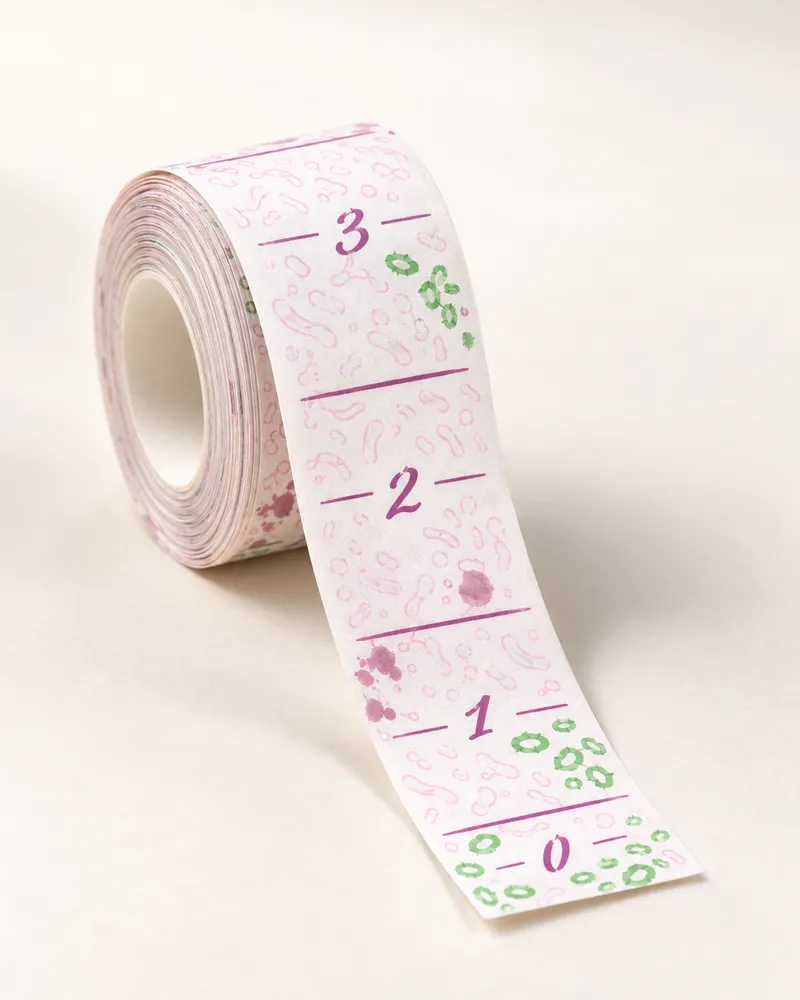
- the amplitude grows on the indicator strip: the difference between your point of maximum relaxation (the laser dot at the top) and your point of maximum tension (at the bottom). Seeing your progress with your own eyes is very motivating;
- in sex there are more pleasant sensations, arousal comes more easily, orgasm is easier to reach, you feel your muscles and control them.
A diary helps a lot. Note how many sets you did and how many times urine leaked during the day. After a month your notes will show whether there is progress.
The magic PionBox: trainers for the pelvic floor muscles
The exercises in the “Healthy and Desired” practicum are done with a trainer and a ball. I give every student a magic box, PionBox: it has everything you need for Kegel exercises to work the way their author once intended. There is resistance, that is, a weight that builds the muscle. And there is biofeedback: it shows that you are doing everything right and gives you the motivation to keep going. Inside there are two trainers and an amplitude indicator strip.
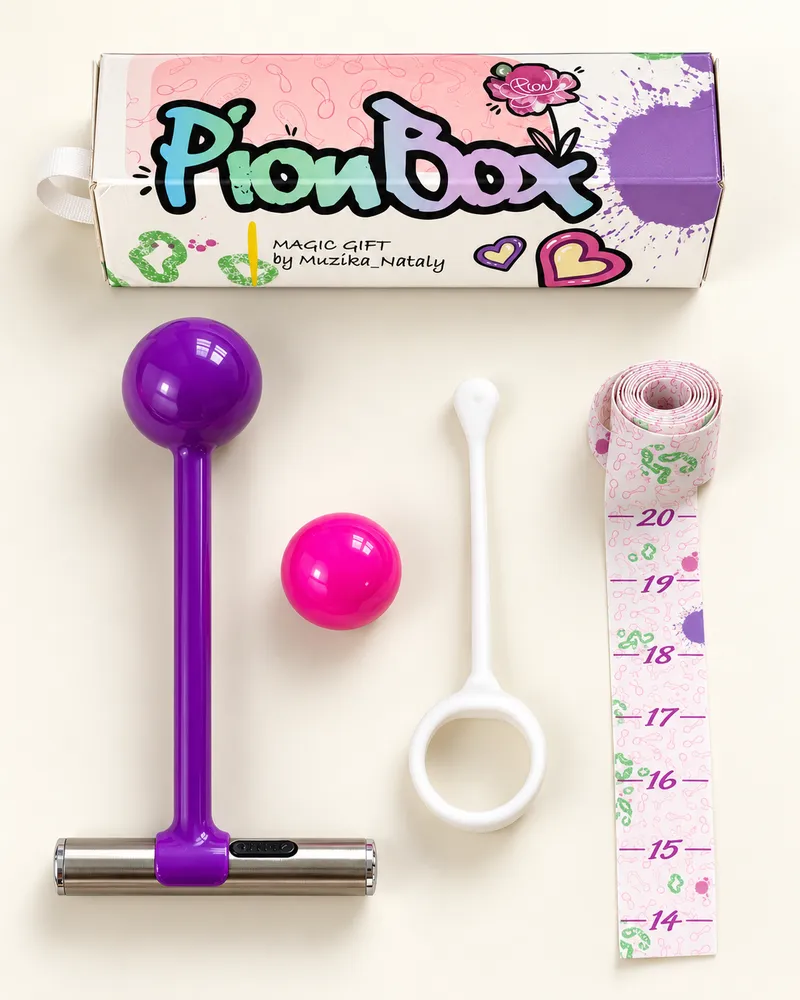
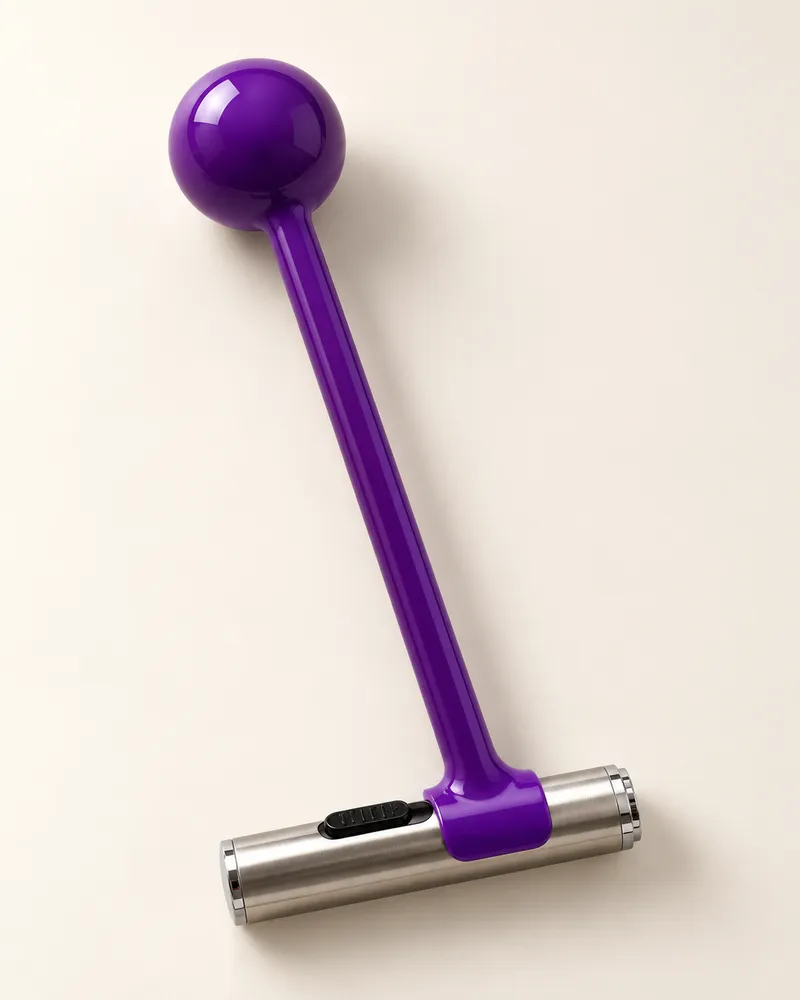
The laser trainer is a wand. A magic wand that every enchantress should own. It gives the pelvic floor muscles the load they need and high-quality biofeedback: the laser dot on the wall instantly shows whether you are squeezing the muscles correctly or pushing at that moment and only making things worse. You see the technique yourself, and in exactly the same way I or a curator see it, even thousands of kilometres away from you. We only need to watch 15–30 seconds of video to praise you or correct your technique. In the practicum I give clear instructions on how to use the trainer so that you get the result you need.
The ball is my own design. Over 10 years of working with women I have understood what it should be like: what shape, what ideal weight, what material. If you think you can buy one like it online or in a sex shop, I have to disappoint you right away: similar balls there are usually made of rough silicone, they stick to the vaginal walls, and you barely have to hold them. My ball is a trainer: its job is to give load to your muscles specifically, and you will have to work to hold it.
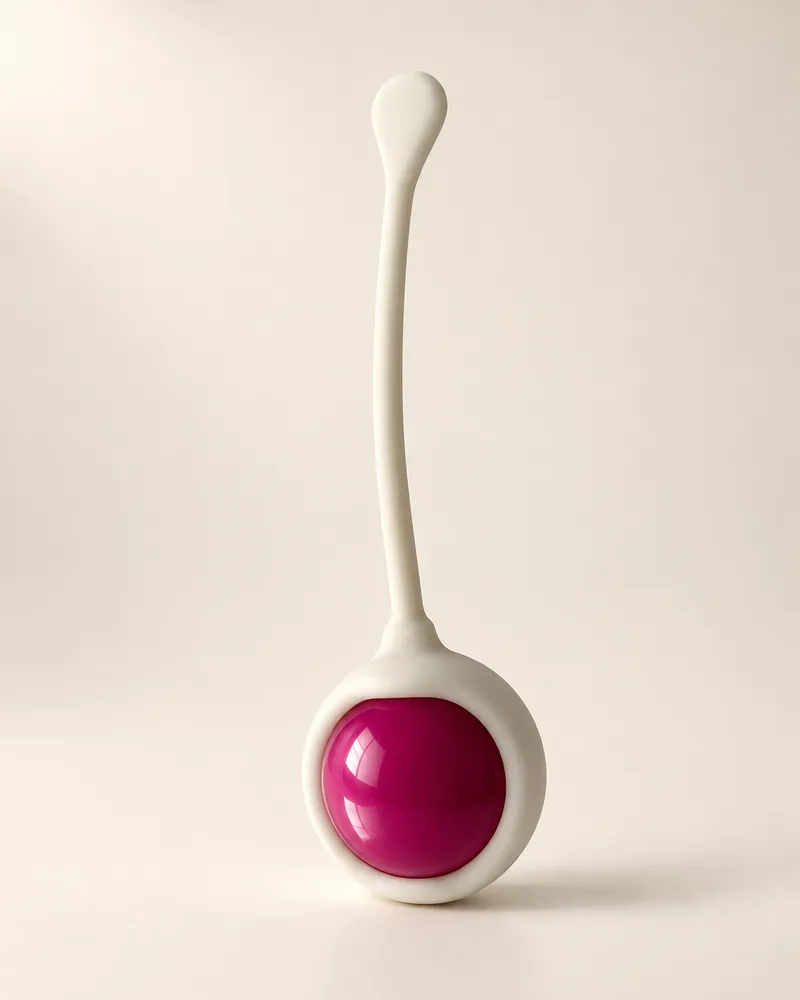

The ball has a removable safety cord. Once you master the techniques I give, you will no longer need it. The worst thing for the pelvic floor muscles is pushing the ball out or squatting down and digging it out with a finger: this is how intra-abdominal pressure works, and a woman squeezes her organs out of herself like cream from a piping bag. That is why I teach you to take the ball out without using your hands, only with breathing and the work of certain muscles. These are the tricks geishas once knew, and this knowledge is never superfluous.
The trainers in PionBox are made of a material that does not react with the mucosa and does not disturb the vaginal microflora. Many “trainers” are actually sex toys: they were made to arouse, not to build the pelvic floor muscles. Only students of my practicum have a PionBox, this knowledge and this box are available to a select circle of women. If you want to be one of them, come.
And if you have been offered sessions in the Emsella chair instead of training, I gave it a separate, honest breakdown: what the Emsella chair really does. Which other trainers are safe and which are better avoided I covered in my review of trainers for intimate fitness.
What it looks like in real life. One of my students could not sneeze without leaking for three years. A few days into the classes she wrote: “For the first time in three years I didn’t wet myself! Four days of warm-up got rid of this problem for me, without medication!”
A trainer without technique and technique without control work briefly, and doing them at random it is easy to give up. I built the “Healthy and Desired” practicum exactly on this: technique, trainers and checking your technique from video reports, so that you don’t train your buttocks while thinking it is your pelvic floor. And that is only the body level: desire and orgasm hold when alongside the muscles we work with your psyche and your state. That way the result stays with you for a long time, not for a couple of weeks.
What about men? Kegel exercises for men
How Kegel exercises for men work (expand)
Yes, men have the same pelvic floor muscles, and Kegel exercises for men work almost the same way. Most often a urologist prescribes them for urine leaks, including after prostate removal, and for dribbling after peeing.
The same gas-holding trick helps a man find the muscles. Another sign: with a correct squeeze the base of the penis pulls slightly upward. The scheme is the same: a squeeze for a few seconds, full relaxation, 10–15 reps several times a day, without the abs and buttocks.
There is data on erections, but it is more modest than for incontinence, and that is a question for a urologist. If in a couple the exercises have become a reason for complaints like “something is wrong with you down there”, that is already a topic for a consultation with me.
Don’t put it off
If you recognise yourself: you leak when you laugh, sneeze or cough, sex brings no pleasure, you are not sure you are doing Kegels right, or you do them but see no results, don’t put it off. The muscles will not build themselves, and prolapse or incontinence will not go away on its own, as hundreds of thousands of my followers have found. A year from now the same task will cost more: both effort and health. Start today, you didn’t read to the end for nothing.
You have two paths.
- Figure it out on your own: blink in a queue without knowing whether these are the right muscles, give up after a couple of days and decide Kegels don’t work (you’ve probably done this already…).
- Figure it out with me. You can come to a free consultation: I or my team will help you find out what your muscles need specifically: strengthening or relaxing first. Knowing the cause and knowing what you specifically should do are two different things. And if you already know you want to work with the body, the head and the state at once, come to me for the “Healthy and Desired” practicum (the practicum is in Russian and Ukrainian).
Sources
- Dumoulin C. et al., 2018, Pelvic floor muscle training versus no treatment for urinary incontinence in women, Cochrane Database Syst Rev
- ACOG, FAQ Pelvic Support Problems
- ACOG, FAQ When Sex Is Painful
- NAMS, 2020, The 2020 genitourinary syndrome of menopause position statement, Menopause
Pelvic floor training and Kegels
Pelvic floor training and Kegels
Questions and answers
Questions and answers
Short answers to the questions people ask most often.
How do women do Kegel exercises correctly?
As a beginner, it is easier to lie down, bend your knees and put your feet on the floor. Squeeze your pelvic floor muscles and draw them in, toward your navel, hold for 1–2 seconds and relax completely. Your belly, buttocks, thighs and face do not help, and do not hold your breath. 15 of these contractions make one set, 3 sets a day.
How many times a day should I do Kegel exercises?
Start with 3 sets of 15 contractions a day. If you want to do more, do more: find your number and increase it gradually. Regularity matters more than one-day records.
How long until I see results from Kegel exercises?
My students notice strong changes as early as the second week of training with trainers. A lasting effect on incontinence takes regular practice: in studies the programmes last for months.
Can I do Kegel exercises while peeing?
Stopping the stream once to feel the muscles is fine. Training like this all the time is not: it disrupts your urination reflexes.
Are there before and after photos of Kegel exercises?
Honest photos cannot exist: the pelvic floor muscles are inside, you cannot see them from the outside. The result shows in your symptoms and on the indicator strip from PionBox, where the amplitude between full relaxation and maximum squeeze grows.
Can I do Kegel exercises after 50?
Yes, muscles respond to training at any age. In menopause it is worth discussing dryness and thinning of the mucosa with your gynaecologist at the same time, that is a separate task.
Can I do Kegel exercises during pregnancy?
Many doctors recommend gentle contractions to prevent incontinence. The decision is up to your obstetrician-gynaecologist, and I do not give trainers or intensive programmes during pregnancy.
Do Kegel exercises help men?
Yes, men have the same pelvic floor muscles. They are trained for urine leaks, including after prostate removal, as prescribed by a urologist.
Can Kegel exercises do harm?
They can, if you push down instead of squeezing, do not relax the muscles fully or train a pelvic floor that is already clenched. Then instead of benefit you get pain, tension and the feeling that the exercises do not work.
Blog
Read next
 Women’s health
The medical term for pain during sex is dyspareunia: recurring pain before, during or after intimacy. Per ACOG, nearly 3 in 4 women have it at least once. Causes lie in the body and in tension: start with a gynaecologist, and work on the fear and spasm with me. Relaxing the muscles is the first thing I teach.
16 min read
No desire for your husband after birth is something many women go through, and the causes are almost always clear. Pain from stitches, dryness while breastfeeding, lack of sleep, a new body and not a minute to yourself. No set date exists for libido to return, but each cause has its own first step.
10 min read
 Desire and libido
How to increase female libido without pills: first remove what is smothering desire (lack of sleep, pain, resentment, sex you force yourself into), then add what fuels it. Below: what stops you wanting at the level of body, head and state, what to do about it, and the signs that you need a doctor.
18 min read

Natalia Muzyka
psychologist and sexologist, body-oriented therapist, art therapist, author of educational programs and books. PhD Candidate in Clinical Sexology, IICS, USA. Member ISSM and AASECT.
Want to work through your own situation? Come to a free consultationNext step
My course on this topic
I have a program that walks you through this topic step by step.
Work through your situation, not a generic scheme
A free online consultation for women and couples, led by me or my team. No generic advice and no judgment.
Sound familiar? Take the free sexuality check-up
Start